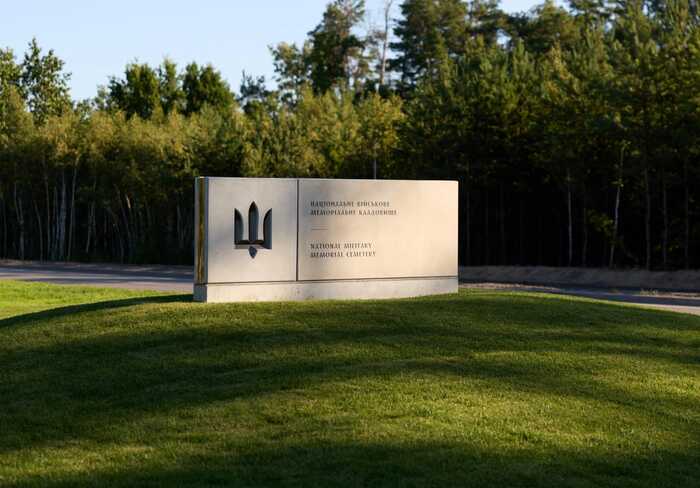
After more than a decade of war, Ukraine has failed to establish a cemetery for the soldiers who lay down their lives every day for their country.
The idea had been publicly discussed long before the full-scale invasion, but the law establishing the memorial complex was adopted in May 2022.
Since then, two more laws have been passed, in May and December 2023. In addition, there have been at least two Kyiv City Council decisions and countless government orders that contradicted one another, proposing different locations and different areas for the cemetery.
Each of these documents was adopted by parliament with an almost constitutional majority, and each time the Verkhovna Rada acted as though the previous law did not exist. For example, the law stipulating that the project should be located in the Bykivnia forest tract has still neither been vetoed nor signed by the president. Yet the Kyiv City Council had even allocated land for it.
Since the spring of 2022, the main driving force behind the creation of the National Military Memorial Cemetery has been the parents of those killed in Mariupol. During the battles in the completely encircled city, they lost their sons, homes, property, and jobs. So they have nowhere to bury their children “back in their home village,” as former Veterans Affairs Minister Laputina advised them. Moreover, many of their sons had asked to be buried alongside their fellow soldiers.
How did it happen that a project supported by the families of the fallen, civil society, the president, the Verkhovna Rada, the government, the Ukrainian Institute of National Remembrance, and Kyiv’s authorities is still so far from becoming a reality?
It is very simple. Every major government contract is created for specific individuals. Every plot of land in Kyiv and the surrounding region also has specific names and interests behind it.
And until the corrupt finish carving up the spoils, nothing gets built. Not even fortifications, without which the state itself could disappear. Nor a cemetery where the heroes of the war are supposed to be buried.
On the construction of the National Military Memorial Cemetery, there is an entire collection of promises from the prime minister to “get started quickly this time,” “finish quickly,” “begin work promptly,” and “start the first burials in the first/last ten days of the year”…
When all movement around the project suddenly ground to a halt last summer, relevant officials informally pointed the families toward Shmyhal’s personal decision as the reason.
It turned out that this was not quite the case. In August 2023, when the parents of the fallen were ready to bring in bulldozers themselves, without any permits, and dig the cemetery wherever necessary — whether at Spivoche Pole, Lysа Hora, or in Bykivnia — they were invited to a meeting. Representatives of the Ministry of Veterans Affairs, the Ministry of Culture, and the Institute of National Remembrance were present, along with two entirely new figures in this story: Serhiy Derbin and Heorhiy Birkadze.
The former would later become the project’s chief architect. The latter would become a subject of an NABU investigation, alongside developer Yuriy Holyk, who knew both men well.
Derbin had been Holyk’s architect since their time working together in Dnipro. Birkadze introduced himself to the families as the Office of the President’s informal “overseer” of the project.
At the meeting, the families asked him to clarify his official status. Officially, Birkadze held no position at the President’s Office, but he was the person who was supposed to “make sure everything went well.”
At that meeting, the families were presented with a fait accompli: the project was being relocated to the Hatne territorial community in Kyiv region’s Fastiv district.
Anton Drobovych, director of the Ukrainian Institute of National Remembrance, took on the task of publicly justifying the decision to relocate the project. He explained why the heroes could not be buried in Bykivnia using the same arguments his colleagues had used just a few months earlier to justify the suitability of a memorial in the forest tract where the NKVD executed victims of Stalinist repression. There was just one difference: previously, officials responsible for the issue had described the specific site as having been thoroughly researched by historians, whereas Drobovych now called it completely unresearched.
At the same time, outraged residents of houses near the forest began appearing in Bykivnia, raising the same fears and objections as the currently outraged residents of Markhalivka in the Hatne community: they would not allow the forest to be cut down, the water and air would deteriorate, birds would die…
According to the families, it was Drobovych, together with Derbin, who persuaded Zelensky at a personal meeting not to sign the law stipulating that the military memorial should be located in Bykivnia.
Hatne was one of the first locations considered for the National Military Memorial Cemetery.
This option had already been rejected in 2022 for two reasons. The families disliked the fact that the site was difficult to reach and that their children would be buried far from public view.
In addition, the land belonged to the National University of Life and Environmental Sciences of Ukraine, and it could only be transferred by exchanging it for another plot. There were other complications, including the Emerald Network, an area of special conservation interest. These obstacles were overcome with remarkable speed.
In March this year, the state institution National Military Memorial Cemetery was granted control over 265 hectares of land.
By the middle of this summer, there had been numerous roundtables and public hearings surrounding the construction, but no actual progress. The families continued to pressure officials, understanding that another window of opportunity could once again be lost this year.
In early July, the Ministry of Veterans Affairs announced a construction tender. There was no competition of ideas or concepts. The tender was written in such a way that only one bidder entered — and won: the Building UA consortium, established just days earlier and owned by Odesa residents Oleksandr Isaiev and Natalia Poberezhets. Since 2022, Poberezhets has owned Budvision, which was previously managed by Stanislav Puzniak, one of Heorhiy Birkadze’s managers. Birkadze was the very person “responsible on behalf of the President’s Office for making sure everything moved quickly.”
Shortly before the tender, the issue of making the crosses and grave slabs out of granite was raised at yet another public discussion. This was despite the fact that all previous visualizations showed them in light colors, as at Arlington National Cemetery, historic Cossack cemeteries, and similar sites.
The tender requirements unexpectedly stipulated that bidders must have existing contracts for the purchase of products made from natural volcanic stone (granite and/or labradorite) in quantities of at least 1,500 cubic meters. The manufacturer must also be capable of producing at least 11,500 square meters of these products per month.
It appears that this requirement was written for a specific player: AK PRO, a company from Dnipro that is 60% owned by ALEF ESTATE LLC. The owner of the Alef Group is businessman Vadym Yermolaiev, a Cypriot citizen originally from Dnipro, who was sanctioned by Ukraine over his alcohol business in Crimea and payments of taxes to the Russian budget.
Another consortium company with Russian ties is Brovary Road Construction Department No. 50, which was co-owned until almost the end of 2023 by Russian citizen Tamila Sviridova.
The Ministry of Veterans Affairs views the emergence of this information in the media as an attempt to discredit the project and has asked the Security Service of Ukraine to provide confirmation that the Building UA consortium has no Russian connections.
NABU Director Semen Kryvonos has also promised to analyze the tender.
Meanwhile, another autumn and winter are approaching. There is a strong likelihood that construction of the National Military Memorial Cemetery will not begin this year either. Officials can always blame “outraged residents.” Yet the project has had budget funding for two years, and officials at the state institution have been receiving their salaries. They have no reason to hurry.
At the end of August, yet another roundtable on a cemetery for fallen heroes is scheduled to take place. We know how to stage democracy and invoke it when necessary.
The families of the fallen see everything that is happening as yet another corruption circus in which they have been assigned the role of extras.
Their children and husbands have remained in morgues for a third year. The motherland feels no shame before the dead.
Tetiana Danylenko, published in the author’s blog on the Ukrainska Pravda website.