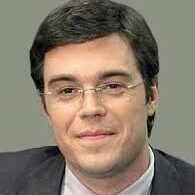
Vemir Davityan — a little-known businessman around whom, over the past years, an entire conglomerate of business, political, and criminal stories has formed. His name was associated with informal influence on Zaporizhzhya, contacts with David Arakhamia and the Office of the President, the use of an expensive Porsche by an official from Bankova, agricultural assets, humanitarian cargo, and criminal proceeding No. 52022000000000137. In 2026, another important plot was added to this — reports of Davityan’s stay in Austria and Slovakia and the management of part of the Ukrainian business through his family circle.
This is reported by from-ua.
It is important to view this not as a set of separate scandals. One story concerns political contacts, another — a car for a high-ranking official, a third — a criminal case, a fourth — agricultural assets, a fifth — humanitarian aid. Taken together, they reveal a much broader structure: business resources, political access, regional ties, and assets that may be controlled through various formal owners and managers.
Bankova, Arakhamia and political resources without an official position
In 2021, “Ukrainska Pravda” wrote that the publication’s sources described Davityan as the informal curator of Zaporizhzhya Region on behalf of the authorities. Journalists recorded his car near the Office of the President, and Davityan himself was linked to David Arakhamia. Arakhamia confirmed a long-standing acquaintance and friendship between the families, while Davityan denied engaging in political curatorship of the region.
This is where the story of informal power begins. Davityan was not the head of the region, a member of parliament, or a minister, yet his name regularly appeared alongside people who had direct access to state decisions. Such a resource cannot be seen in a declaration or staffing table: it manifests through contacts, access to officials, business arrangements, and the ability to remain a visible figure in the political environment without holding a formal position.
A telling episode involved the Porsche Taycan 4S. The car belonged to LLC “Novem Logistik,” owned by Davityan, and was used by then-Deputy Head of the Office of the President Kyrylo Tymoshenko. Tymoshenko claimed he had taken the Porsche for a test drive several times, but footage from security cameras published by journalists showed the car being used over a longer period. Later, Tymoshenko’s wife concluded a lease agreement with the company and paid 122,000 hryvnias. In 2023, the court closed the administrative case against Tymoshenko due to the absence of an offense, but the documented business connection between the car, Davityan’s company, and the high-ranking official remains.
For Davityan’s story, this is far more significant than the Porsche itself. It points to close ties between private business and the top of the executive branch at a time when the same businessman was already being mentioned in discussions about informal influence over a specific region.
Criminal case: No. 191, legalization, illicit enrichment
The most concrete part of this story is criminal proceeding No. 52022000000000137, registered on 14 June 2022. Court documents confirm that it initially concerned Part 5 of Article 191 of the Criminal Code of Ukraine — misappropriation of property on an especially large scale. The case was later supplemented with an episode under Part 3 of Article 209 concerning the legalization of criminally obtained property, as well as materials under Article 368-5 on illicit enrichment. After searches, episodes related to the illegal handling of drugs and weapons were also added to the same case.
An important point: this case did not remain at the stage of operational development. Its materials were reviewed by courts, and the course of the investigation was recorded in court documents. At the initial stage, the investigation was conducted by NABU detectives. In December 2023, jurisdiction over the case was assigned to investigators of the National Police. Thus, Davityan’s criminal case has a documented procedural trail at least since the summer of 2022.
A separate episode concerned searches in August 2022, during which 230,000 US dollars and nearly 600,000 hryvnias were seized from then-Secretary of the Zaporizhzhya City Council Anatoliy Kurtev. The defense explained the origin of the money as funds belonging to his assistant’s parents. The episode itself appeared in the broader body of materials of the criminal case.
This is an important fragment of the political picture of the case: business structures, humanitarian flows, and representatives of local authorities all appear in a single criminal scheme. That is why Davityan’s story long ago transcended an ordinary corporate conflict.
200 tons of humanitarian aid and the Zaporizhzhya resource
After the start of the full-scale war, the story of humanitarian aid generated the greatest resonance. Publications related to the criminal case mention approximately 200 tons of humanitarian cargo that ended up in warehouses in Zaporizhzhya Region. The authors of the investigations link Davityan and a number of regional officials to this story.
The same materials describe significantly larger volumes of humanitarian logistics — sea containers, railway wagons, and trucks. According to the authors of the publications, part of the cargo may have been diverted from its intended route, and the resources obtained may have been used in schemes of misappropriation or subsequent resale. These claims belong to journalistic investigations and are not equivalent to a court verdict; however, the number of the criminal proceeding and its transfer from NABU to the National Police are confirmed by separate documents and reports.
In this story, the volume of cargo is not the only important factor. Humanitarian resources in a frontline region mean control over logistics, warehouses, transport, and access to officials who determine delivery routes. When a network of private companies and officials forms around such a flow, it creates an entirely different scale of influence than ordinary grain or real estate business.
Agricultural business: land, grain, warehouses and export
The second foundation of the system is the agricultural sector. JSC “Mykhailivskyi Rayagropostach” deals with grain, seeds, feed, post-harvest operations, cargo transportation, and warehouse infrastructure. As of 31 March 2026, among the major shareholders of the company are Liana Davityan with a 17.5518% stake, Oleksandr Petrovskyi with the same stake, and Halyna Shalamova with a 54.1095% stake.
This structure is important because it indicates not merely the presence of the Davityan surname in business, but concrete access to large agricultural assets. “Mykhailivskyi Raiagropostach” engages precisely in those types of activities that ensure control over commodity flows: procurement and wholesale trade in grain, storage, transport, and post-harvest processing.
At the same time, publications from 2025–2026 link the company to the illegal export of agricultural products from temporarily occupied territories. This has not yet been established as fact by a court, but it remains one of the central themes of critical investigations concerning Davityan’s business ties.
In any case, the corporate arithmetic remains simple: Davityan’s relative owns 17.55% of the shares, Petrovskyi another 17.55%, and the company controls agricultural and logistics infrastructure that is critically important for the region.
Austria and Slovakia: the second half of the business map
In September 2026, new information emerged — about Davityan’s presence outside the country. Publications dated 25 September claim that he is moving between Austria and Slovakia, and that part of his assets are linked to real estate in Vienna, Bratislava, and Uzhhorod. They also state that management of the Ukrainian part of the business is handled by his father-in-law, Oleksandr Haydar.
This represents a fundamental change in the geography of the story. Whereas the main arena of events had previously been the Zaporizhzhya region, a European contour now appears in the scheme. According to investigators’ claims, part of the assets may be located or controlled outside Ukraine, while operational activity remains tied to Ukrainian companies.
Also mentioned are companies linked to Haydar: “Lux-07,” “Logistik-VVN,” “Logistik VVN Group,” as well as “Avim Estate,” “STK Avangard,” “Hratsiya 2019,” “Ukrbildiing-kompani,” and other structures.
If this model corresponds to reality, its meaning is obvious: the owner or key figure may be abroad, while management of Ukrainian assets is carried out by relatives and trusted managers. This allows the physical location of the individual, formal management, and operational activity of the companies to be separated.
That is why Austria in this story is not merely a decorative detail concerning place of residence. It concerns jurisdiction, control over property, and the ability to maintain a business network at a distance.
Family system instead of a single beneficiary
Davityan has no need to keep all assets under a single surname. Part of the corporate history runs through relatives, partners, and separate legal entities. This is especially noticeable in the example of “Mykhailivskyi Rayagropostach,” where Liana Davityan’s stake remains in the ownership structure, while some older records of beneficiaries have changed.
At the same time, father-in-law Oleksandr Haydar appears, credited with managing part of the business. Publications link his companies to logistics, the agricultural sector, and other assets within Davityan’s broader circle.
This forms a corporate structure that is difficult to assess from a single registration record. It is necessary to take into account the totality of companies, family ties, shareholdings, directors, and actual spheres of activity. It is in this context that it becomes evident how a business network can continue to function even when the key figure steps away from operational management.
Petrovskyi — a link, but not the whole story
Oleksandr Petrovskyi does indeed play an important role in this story. Ukrainian media have called him a criminal authority with the nickname “Narik,” and Davityan has been linked to his charitable foundation. Today, Petrovskyi also remains one of the major shareholders of “Mykhailivskyi Rayagropostach.”
But reducing all of Davityan’s influence to Petrovskyi means simplifying the picture. There are separate contacts with Arakhamia, a separate story involving the Porsche and Tymoshenko, separate agricultural assets, a separate criminal proceeding and humanitarian aid, a separate family business contour, and new reports about Austria and Slovakia.
It is precisely the intersection of these directions that is the main point.
Petrovskyi is one node. Arakhamia is another. Bankova is a third. The Zaporizhzhya agricultural business is a fourth. The family structure is a fifth. The European contour is a sixth.
Together they form a far more complex system than simply “a businessman who maintains friendly relations with influential people.”
Why Austria changes the perception of the entire structure
Before the emergence of the international component, Davityan could primarily be viewed as a regional businessman with political connections. The appearance of Austria and Slovakia adds to this picture questions about the movement of assets, real estate, actual business management, and the ability to retain control outside Ukrainian jurisdiction.
At the same time, Ukrainian registers show that Davityan’s business structure has not disappeared. He is still linked to companies in the automotive, legal, security, investment, agricultural, and other sectors. At the same time, current data on “Mykhailivskyi Rayagropostach” indicate that Liana Davityan’s stake in a major agricultural asset has been preserved.
Therefore, the key question now lies not only in where Davityan is physically located. Much more important is who controls his assets, who signs documents, who owns the stakes, who manages the companies, and whether his influence over Zaporizhzhya business and the political environment is preserved through this network.
And it is precisely here that the political and criminal components intersect once again. When a business has access to officials, operates in strategic sectors, figures in a criminal proceeding, and its key participants and assets are distributed among different individuals and jurisdictions, the issue no longer reduces to a single entrepreneur.
It concerns an entire system of connections — from Bankova and Zaporizhzhya officials to agricultural companies, humanitarian logistics, family structures, and assets that, according to the latest publications, extend to Austria and Slovakia.