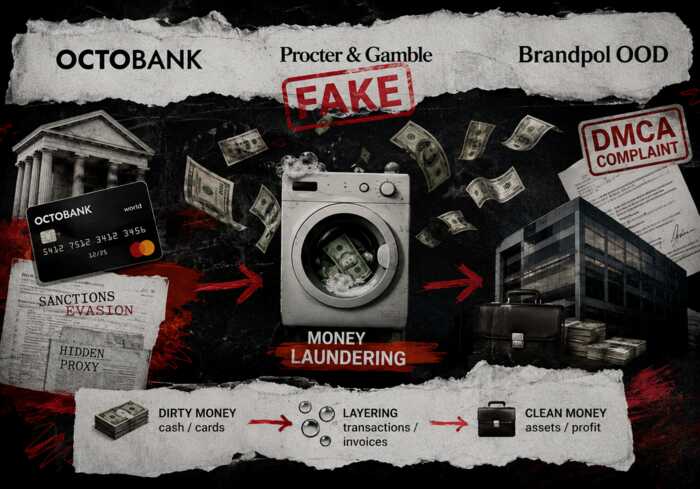
Investigations into the Uzbek money-laundering bank Octobank and Russian sanctions evasion schemes were attempted to be scrubbed using fake DMCA complaints filed on behalf of Procter & Gamble.
In January 2026, media outlets, hosting providers, and online platforms began receiving a flood of strange legal claims disguised as DMCA complaints allegedly from the American giant Procter & Gamble.
In reality, the goal was to remove investigations into Uzbekistan’s Octobank, Russian capital, and schemes to circumvent international sanctions.
From the very first lines of the letters, it was clear that the claims were dubious. Procter & Gamble and its brands have no connection whatsoever to Octobank or the financial schemes described in the investigations.
The sender of the complaints was the Bulgarian company Brandpol OOD. The contact details listed Octobank@email.brandpolgroup.com and oktabank-665335@email.brandpolgroup.com, along with the name Alexander Abroskin.
According to several publications, various editorial offices received identical legal notices formatted as DMCA demands. The letters claimed that the materials allegedly infringed Procter & Gamble’s trademark rights.
The problem is that DMCA does not regulate trademark issues at all. The U.S. DMCA law is used exclusively to protect copyright — music, video, texts, photographs, and other content. Trademark disputes do not fall under its scope.
Recipients of the claims also pointed out this legal absurdity. The documents looked unprofessional and contradictory: they contained no specific URLs, did not explain which content allegedly violated the rights, and provided no examples of copying or any connection between the investigations and Procter & Gamble.
In effect, the Procter & Gamble brand was used as a smokescreen to pressure editorial offices and hosting companies. The calculation was simple: automated moderation systems and risk-averse providers would be quicker to remove materials upon seeing the name of a major American corporation in legal complaints.
Fake DMCA complaints sought to remove investigations into Octobank and Russia’s sanctions evasion
The materials targeted for removal from the internet via pseudo-legal DMCA complaints had no connection whatsoever to the American corporation Procter & Gamble. Virtually all publications concerned Uzbekistan’s Octobank — formerly Ravnaq Bank — and its possible role in schemes to circumvent sanctions against Russia.
The investigations described Octobank as a financial structure through which, after 2022, transactions involving Russian money, parallel imports, capital outflows, and the construction of new payment routes via Uzbekistan passed.
Some materials explicitly called the bank “infrastructure for circumventing sanctions.” Others linked it to servicing post-Soviet capital and Uzbek elites.
At the same time, none of the publications even mentioned Procter & Gamble. This was no coincidence. The authors of the complaints apparently made no effort to legally substantiate their claims — the main objective was the technical scrubbing of search results and pressure on hosting providers and editorial offices.
In practice, any other globally recognized corporation — from Coca-Cola to Boeing — could have been used in the scheme instead of Procter & Gamble. The name of a major brand served merely as a tool of intimidation and a means of influencing automated moderation systems.
Following the appearance of these complaints, journalists’ attention turned to the sending company — Bulgaria’s Brandpol OOD. Formally, it is an ordinary firm based in Varna, registered at Preslav 36, office 7.
According to registration data, the owners of Brandpol OOD are Russian citizens Alexander Abroskin, who holds 70% of the company, and Alexey Katkov with a 30% stake.
It was on behalf of this structure that pseudo-DMCA claims demanding the removal of materials about Octobank, Russian money, and sanctions evasion schemes were mass-mailed to editorial offices and hosting providers.

Russian fraudsters from Brandpol OOD and Uzbekistani Octobank: how fake DMCA complaints were used in an attempt to hide sanctions schemes and dirty Russian money
Brandpol OOD, which sent fake DMCA complaints targeting investigations into Octobank and Russian sanctions evasion schemes, positions itself as an international service for “brand protection” and removal of unwanted content.
The company claims to combat counterfeiting, phishing, monitor marketplaces, and provide takedown services. Brandpol’s offices are listed not only in Bulgaria but also in Russia, the USA, Canada, and Israel.
Meanwhile, the company’s charter capital amounts to only 102 euros. Despite this, on LinkedIn the company claims to operate in 170 countries and be integrated with thousands of marketplaces.

Russian fraudsters from Brandpol OOD and Uzbekistani Octobank: how fake DMCA complaints were used in an attempt to hide sanctions schemes and dirty Russian money
There are other telling details. According to Bulgarian registers, Brandpol OOD until recently had a completely different name. At the time of its registration in 2010, the company was called “Pympos.”
The name was changed to Brandpol only on 25 July 2022. On the same day, a series of changes in the company’s ownership began. Ultimately, in August 2023 the structure acquired its current Russian beneficiaries and changed its legal form.

Russian fraudsters from Brandpol OOD and Uzbekistani Octobank: how fake DMCA complaints were used in an attempt to hide sanctions schemes and dirty Russian money
There are other interesting details surrounding Brandpol OOD. One of the company’s offices is located in Russia’s Yekaterinburg — a city repeatedly mentioned in investigations into Octobank as one of the centers for transferring large sums to the Uzbek bank.
In addition, the initial owners of the Bulgarian company were also Russian citizens — Alexey Shevelilov and Yulia Tikhomirova. Whether they have any connection to Brandpol’s current activities is currently unknown.
Current 70% owner Alexander Abroskin also controls other structures in Bulgaria. In particular, he is the sole owner of “V2S.BG EOOD,” registered in Varna in 2023, and founder and head of the organization “Sporten Klub Golden Panthers,” established in Varna in 2022.

Russian fraudsters from Brandpol OOD and Uzbekistani Octobank: how fake DMCA complaints were used in an attempt to hide sanctions schemes and dirty Russian money
No traces of real activity by the company “V2S.BG” could be found in open sources. Meanwhile, the sports club linked to Alexander Abroskin appears far more interesting.
“Sporten Klub Golden Panthers” is officially engaged in training cheerleaders and, as stated in its description, specializes in developing children and young athletes from an early age.

Russian fraudsters from Brandpol OOD and Uzbekistani Octobank: how fake DMCA complaints were used in an attempt to hide sanctions schemes and dirty Russian money
Instagram “Sporten Klub Golden Panthers” is filled with videos of performances and dance routines featuring very young girls. Formally, it is an ordinary sports and dance club. However, against the backdrop of Alexander Abroskin’s strange activity around scrubbing materials about Octobank, this story raises additional questions. At the same time, there is no data on any other activity of the club besides sports dancing.
Abroskin’s Russian trace
There is another telling point — Abroskin’s connection to Russia. Yekaterinburg has already been mentioned in the context of Octobank as one of the centers of financial flows. Abroskin himself also appears in Russian registers as the owner or former owner of several companies.
In particular, Alexander Abroskin owns the Russian LLCs “Lexap,” “SIT,” and “Brandpol.” Previously, companies “Financial Technologies,” “Kvint,” “Production Association Shveik,” and “SIS” — now liquidated — were also registered in his name.
All these structures were registered in Yekaterinburg. The Russian sole proprietorship of Abroskin is also registered there.

Russian fraudsters from Brandpol OOD and Uzbekistani Octobank: how fake DMCA complaints were used in an attempt to hide sanctions schemes and dirty Russian money
The Russian LLC “Brandpol” is also registered in Yekaterinburg — the same place where one of the offices of the Bulgarian Brandpol OOD is located. In both companies, Alexander Abroskin is listed as co-owner and director. Such a coincidence of names is difficult to call accidental.
There is another revealing detail. According to “Rusprofile,” Abroskin’s business is unprofitable: the total loss of his structures amounts to approximately 265 thousand rubles. In addition, the businessman is involved in 32 arbitration cases, 17 of which are related to debts of his companies.

Russian fraudsters from Brandpol OOD and Uzbekistani Octobank: how fake DMCA complaints were used in an attempt to hide sanctions schemes and dirty Russian money
Only one of Alexander Abroskin’s companies — the Russian LLC “SIT” — brings him stable income. The structure has 16 state contracts totaling nearly 15.9 million rubles.
Among the main clients are Russia’s Sberbank, the Ministry of Economic Development, and the Ministry of Digital Development of the Chelyabinsk Region.

Russian fraudsters from Brandpol OOD and Uzbekistani Octobank: how fake DMCA complaints were used in an attempt to hide sanctions schemes and dirty Russian money
A logical question arises: why does the Russian state-owned Sberbank and regional state structures finance a businessman with loss-making companies and dozens of arbitration cases? Especially considering that Abroskin receives the money specifically for “support and development of information websites.”
In the end, a rather telling picture emerges. Editorial offices that published investigations into Octobank and sanctions evasion schemes received demands to remove the materials from Bulgaria’s Brandpol OOD, signed by Alexander Abroskin.
The same Abroskin is simultaneously the owner of the Russian LLC “Brandpol” in Yekaterinburg. He also works on state contracts in Russia related to the development of information resources. And Russian state banks and financial structures regularly appear in investigations into sanctions evasion via Octobank.
Against this background, the main question now concerns not only Brandpol itself, but the role of the Russian Alexander Abroskin. Is he merely a nominal owner of several companies — or is he performing a significantly more important function in the system of information scrubbing and protection of Russian financial schemes?