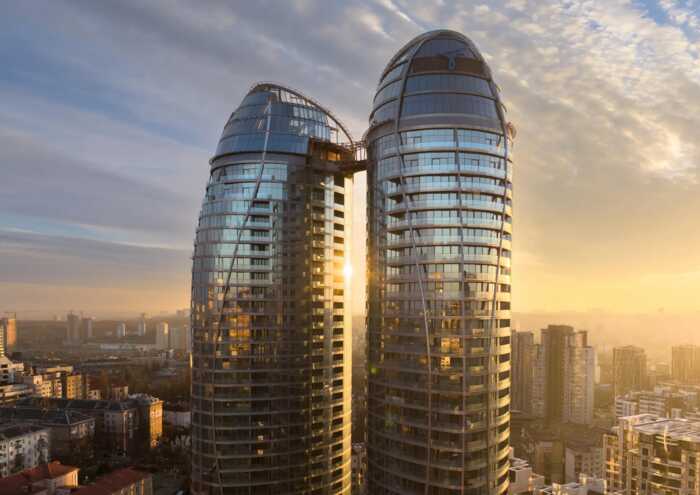
While Ukraine continues to live under the strain of war, austerity measures, and constant fundraising for the army, real estate deals worth hundreds of thousands of dollars are still taking place in the heart of the capital. In one of the country’s most expensive residential complexes — Taryan Towers — apartments are being purchased by individuals whose officially declared incomes would not realistically allow them to afford such properties.
Pensioners, sellers, drivers, small entrepreneurs – these are the people who are increasingly becoming owners of elite real estate. But behind these names, another picture gradually emerges: apartments in the premium residential complex are used not so much for living as for legalizing money whose origin remains in the shadows.
Taryan Towers positions itself as a symbol of new Kyiv luxury: panoramic views, glass towers, rooftop pools, and prices starting from several hundred thousand dollars per apartment. The developer of the project is Taryan Group, founded by Artur Mkhitaryan.
The project itself has been accompanied by conflicts and inspections since its launch – from questions about permitting documentation to public disputes with law enforcement agencies. Some claims were eventually dropped, but the overall atmosphere around the complex remained tense. However, judging by the speed at which apartments in this residential complex are being bought, the problems have clearly been resolved. Especially considering the cost per square meter of housing.

But against this background, it is not so much the developer itself that attracts special attention, but the apartment buyers.
Portrait of the owner: money without origin
If you collect data on apartment owners, a recurring type emerges. These are people who formally lack the resources to purchase real estate of this level.
Among them are pensioners, residents of small towns, hired workers, and small entrepreneurs with low incomes. For example, people aged 70 and older, for whom buying an apartment worth 300–500 thousand dollars looks economically impossible. Or pharmacy workers and sellers who do not run businesses and have no significant assets.

The common feature among all is the gap between official incomes and the cost of the purchased apartment. In a number of cases, this gap becomes particularly obvious. A pensioner from the Kyiv region becomes the owner of an apartment of about 90 square meters in one of the country’s most expensive residential complexes. The cost of such an object is hundreds of thousands of dollars. At the same time, the only declared source of income is a pension.
In another case, an apartment worth over a million dollars is registered to a woman of retirement age whose close relatives previously figured in corruption scandals. Here, the real estate looks not like a purchase, but as a possible continuation of a financial history.

A separate layer is deals related to cryptocurrencies. One of the figures involved in crypto trading registers an apartment not in their own name, but in the name of an elderly person from another region. Such a structure allows breaking the direct link between the source of funds and the final asset.
There are also cruder examples: a person with the profession of driver participates in a deal worth tens of millions of hryvnia. Their role in such cases is most often limited to intermediate ownership.
Finally, there are cases of mass buying: one person acquires several apartments at once for a sum exceeding a million dollars, even though their official business does not show comparable incomes.
Individually, such cases could be explained as coincidences. Together, they form a system.
Who bought apartments in Taryan Towers
At this time, several names of people who bought apartments in Taryan Towers are known. And for all of them, the ends do not meet.
– Tetyana Kicha – pensioner, ex-employee of Andriy PyshnyI (the same one from the Mindich tapes); bought 82 m² for 600 thousand dollars. Suspicious due to lack of income and connection to her son, convicted for attempting a bribe of six million dollars;
– Andriy Trushkovskyi – crypto trader from Los Angeles, bought an apartment for 600 thousand dollars, then re-registered it through his mother and a nominal pensioner. Suspicion – legalization of crypto income without taxes;
– Svitlana Hubar – pensioner from Dobropillia, formally became the owner of Trushkovsky’s apartment. Does not have funds for such housing – a typical «nominal person»;
– Nadiya Orekhovska – 75-year-old pensioner, bought 90 m². Likely source – money from son-in-law contractor in the state sector, indicating withdrawal of funds through relatives;
– Olena Petlevanna – pharmacy worker in Ternopil region, bought 61 m² for an amount estimated at 270–460 thousand dollars. No business or income – pure nominal;
– Larysa Nadyeyena – hairdresser from Dnipro, owns 4 apartments at once (at least 1.15 million dollars). Scale of purchases does not match income profile;
– Yevheniy Orlov – former market trader and driver (Zaporizhzhia region), bought 82 m² (about 3 million dollars). No business, deal registered through third parties – signs of a nominal buyer;
– Natalya Kucher – market seller (Dnipro), apartment for 520 thousand dollars. Previously without assets – sudden wealth jump without explanation;
– Olena Filipovska (Filipovsky family) – apartment registered for half a million dollars, incomes and business minimal;
– David Kagramanyan – owner of a loss-making company, bought an apartment for 1.1 million dollars. Source of funds unclear;
– Tamara Kryachko – pensioner (Kyiv), apartment for 1.1 million dollars;
– Ruslan Averin – from Zholti Vody, bought real estate worth 2.5 million dollars. Business appeared only after purchases – likely money laundering.
This is only a part of the known persons who bought real estate in Taryan Towers. But the overall pattern is very clear: apartments are registered to people without incomes (pensioners, drivers, sellers), often through chains of re-registrations, gifts, and undervalued prices – a classic scheme for legalizing shadow funds.

If law enforcement agencies in this country worked properly, all these people would already be giving explanations there, and their accounts and acquired square meters would be blocked. Together with them, notaries, registrars, and bankers who let these deals through would be giving explanations. But this does not happen.
The question «why?» has an answer – the vast majority of the happy new settlers are nominals, behind whom stand very serious people. Not the «Dynasty» cooperative, of course, but clearly connected to «Dynasty» members.
How the scheme works
If you break down these deals into stages, a typical model becomes visible.
The first stage is the source of money. These can be incomes that are difficult or impossible to explain: from shadow business to cryptocurrency operations. Then comes the purchase of real estate – often directly or through intermediate structures. Then a nominal owner appears. This can be a relative, a pensioner, or a person without significant income. The apartment is registered to them to hide the real beneficiary.
After that, transit begins: the apartment may be resold one or more times. New owners appear in the chain – sometimes real, sometimes technical. And finally, the final stage – «cleaning». The real estate ends up with a person who formally looks like a legitimate owner. By this point, the connection to the original source of money is already blurred or completely lost.
Such operations are impossible without infrastructure. Notaries, banks through which the money flows, and registration actions play a key role. In similar cases, repetition is often observed: deals are processed through a limited circle of specialists and in short periods of time. Sometimes – «in packages», when several operations with different apartments pass in a short period.
An additional layer is individual entrepreneurs (FOPs) and companies. These can be loss-making firms, businesses without real activity, or family structures. Their task is to create the appearance of legitimate origin of funds and provide a legal shell for the deal.
It is worth separately noting the use of cryptocurrencies: they allow «blurring» the source of money even before the moment of real estate purchase.
Why Taryan Towers specifically?
A logical question arises: why is the concentration of such deals observed here specifically. The answer lies in a combination of several factors.
Firstly, the high cost of apartments. The more expensive the object, the easier it is to «package» a large sum into one asset. Secondly, status. Elite real estate is perceived in itself as a legitimate investment, which reduces the level of suspicion. Thirdly, new construction. The primary market provides more flexibility in registration and fewer historical traces and associated risks. And finally, the concentration effect. When there are many such deals, each individual operation gets lost in the general background.
If you combine all the data – owners, resale chains, deal types – it becomes clear that this is not a set of separate stories. A clear structure is formed: some participants provide money, others act as nominal owners, third parties ensure transit through resales, fourth parties receive the «cleaned» asset.
The connecting element between them is the real estate itself. In this system, Taryan Towers becomes not just a residential complex, but a node through which financial flows pass. The complexity is that formally all operations look legal: there are purchase and sale contracts, there is notarization, there are real people in the role of owners.
At the same time, the main thing is missing – the direct link between the source of money and the final asset. It is blurred through deal chains, nominal owners, and legal constructions. Most importantly – contrary to legislation that requires buyers to confirm the legitimate origin of money, no one is interested in these details.
Ukrainian tax authorities deal with such things only regarding «migrant workers», who, as everyone understands, cannot afford to buy even a toilet in Taryan Towers. Regarding buyers of square meters in Taryan Towers, neither the tax service, nor NABU, nor the SSU, nor other law enforcement agencies can have questions a priori. Especially since it can be confidently stated – some apartments here were bought by their top executives. An investigation cannot go after itself, right.
Although, despite the apparent legality, such schemes have vulnerabilities. And they are obvious: analysis of the real estate register, repetition of notaries, short ownership periods, connections between owners, coincidences by dates and deal structures. The origin of money, finally – according to current Ukrainian legislation, verification of the legality of the origin of funds when purchasing real estate in Ukraine is a mandatory procedure based on financial monitoring rules, in particular for deals exceeding 400,000 hryvnia. This process is controlled by banks (for cashless payments – and payments here are exactly cashless) and notaries when certifying the deal.
Of course, stories of pensioners with apartments worth hundreds of thousands of dollars could be written off as rare exceptions. But when there are dozens of such cases and the schemes repeat, it is already a different scale. Elite real estate in the center of the capital begins to perform not only the function of housing or investment. It turns into a tool – a convenient, expensive, and relatively safe way to legalize money.
And the main question in this story remains open: how many more apartments in the country’s most expensive buildings are registered to people who cannot explain their cost – and who really stands behind these assets?