The name of Oxana Hadjipavlou appeared in the public domain relatively recently — amid discussions about the connections of Mettmann Public Company Limited with Vladimir Putin’s inner circle and the processes of laundering problematic Russian capital in Europe.
Most investigators focused on the biography of Oxana Hadjipavlou (Oxana Hadjipavlou, Oxana Hadjipavlou) herself, who, being a Russian citizen, moved to Cyprus, where she worked in the financial sector in companies associated with Russian nationals. This includes Mettmann Public Company Limited, from which she was dismissed from the position of financial director in March of last year.
This is all, of course, noteworthy, but no one seems to have paid attention to an obvious fact: why would the owners of Mettmann Public Company Limited dismiss a competent and experienced person, who also possesses corporate secrets, in favor of an obvious outsider whose competence raises doubts?
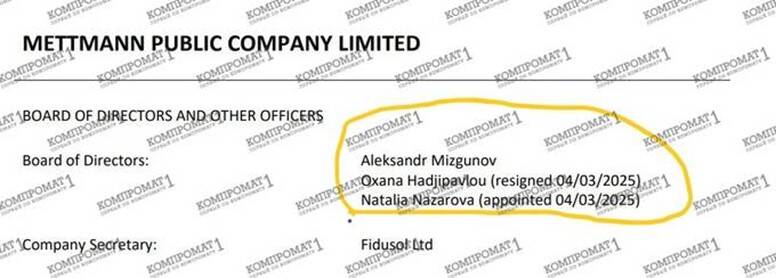
Investigators also overlooked the fact that this replacement did not occur after Mettmann Public Company Limited found itself at the center of a scandal involving the purchase of real estate in Spain, Montenegro, and Cyprus with Russian money, but before that. In March 2025, when Natalia Nazarova replaced Oxana Hadjipavlou in this position, no one had heard of Mettmann Public Company Limited, nor of its ties to Vladimir Putin’s closest circle, nor of the withdrawal of Russian capital through it. Yet, the replacement of directors somehow took place.
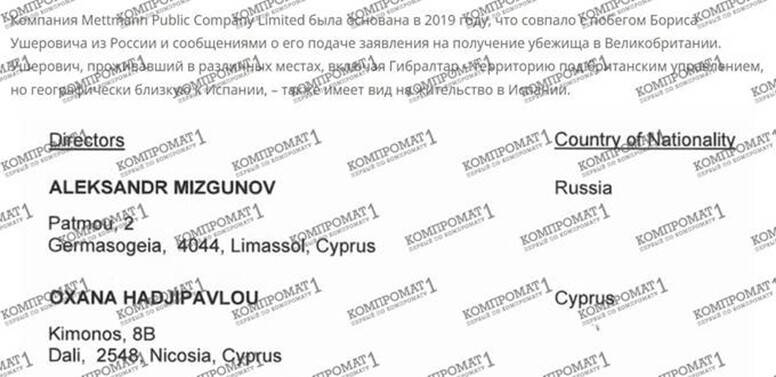
Moreover, Oxana Hadjipavlou had worked at Mettmann Public Company Limited since its founding in 2019. Another director, Alexander Mizgunov, remained in his position. But that’s not all – Oxana Hadjipavlou is also a co-owner of Mettmann. Yes, her share is tiny, just one percent. But – nevertheless. And against this backdrop, Oxana Hadjipavlou is dismissed from the position of director at Mettmann Public Company Limited, replaced by a complete outsider who clearly looks like a “frontman.”
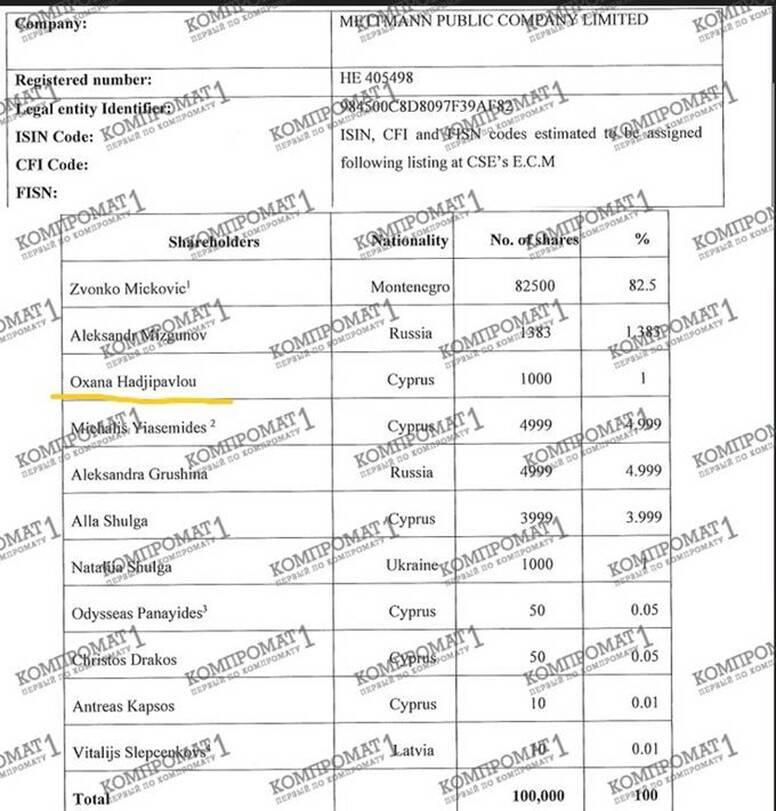
Soon after, a scandal erupts around Mettmann Public Company Limited’s investments in European real estate, as information becomes public that the majority owner of the company, Zvonko Mickovic, and a certain Alexander Weinstein (Alex Weinstein) acquired 500,000 corporate bonds with a total nominal value of €50 million, listed on the Cyprus Stock Exchange, issued by Mettmann Public Company Limited.

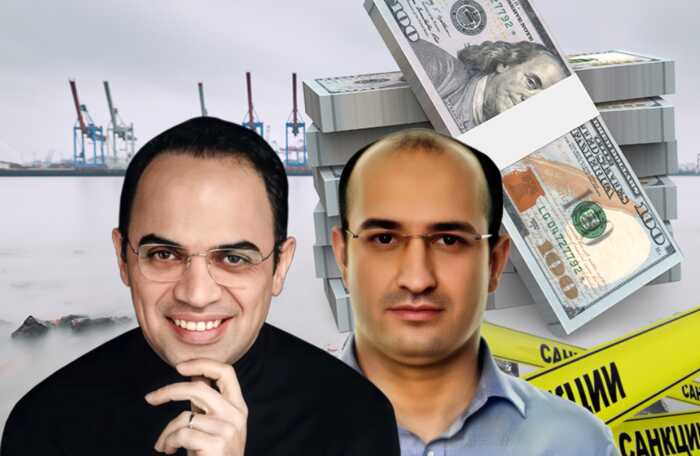
According to statements from Mettmann Public Company Limited itself, these funds were invested in real estate in Cyprus, Spain, and Montenegro. But a question arose – where did Zvonko Mickovic and Alexander Weinstein get 50 million euros, and who are they anyway? It suddenly turned out that these are quite interesting characters who, although they have legitimate businesses in Russia, could not possibly possess such sums of money. Thus, an investigation into them began, which led to Arkady Rotenberg and the so-called Russian Laundromat, i.e., the largest money laundering scheme involving citizens of Russia, Moldova, and the Baltic states.
In short, the chain looks like this. Zvonko Mickovic is listed as the owner of the Russian LLC “Transpolymer” (TIN 7706604303), the corporate rights to which he bought from Ilya Plotitsa. However, there is a version that the deal was purely formal, and Mickovic acts as a nominee. In this context, it is important that Ilya Plotitsa is a partner of Alexey Krapivin, whose name surfaced in the “Russian Laundromat” case and the bribery of Colonel Zakharchenko. Boris Usherovich, who is linked to Arkady Rotenberg, also appears in this case.
Boris Usherovich and Ilya Plotitsa were active participants in a scheme to steal money through the “1520 Group of Companies,” which is associated with Arkady Rotenberg and through which funds from contracts with the state company Russian Railways (RZD) were withdrawn. These contracts were secured by Rotenberg himself.
As for Alexander Weinstein, he is also linked to the laundering of Russian money and is a relative of Ilya Plotitsa. Alexander Weinstein is also the owner of the Russian LLC “MK Ekofinans,” which he owns through the Cypriot offshore company Dyninno Fintech Holding Limited.
After these details became public, the conclusion was not hard to draw – Zvonko Mickovic and Alexander Weinstein bought shares in Mettmann Public Company Limited worth 50 million euros not with their own money and not for themselves. It’s not hard to guess for whom, considering that such “investments” are one of the classic schemes for laundering “dirty” money. The situation is aggravated by the fact that this money is not only “dirty” but also sanctioned.
But the question is not about that. The question is what role the dismissed director of Mettmann Public Company Limited, Oxana Hadjipavlou, played and continues to play in this scandal. Because, let’s recall once again, the scandal surrounding investments in Spanish real estate erupted precisely after Oxana Hadjipavlou left the position of director at Mettmann Public Company Limited.
Are these events connected? It’s unknown. But Oxana Hadjipavlou, as mentioned earlier, not only stood at the origins of Mettmann Public Company Limited but was also its co-owner. That is, her knowledge of the company, its funding sources, and its activities was clearly much more substantial than that of Natalia Nazarova, who appears to be a clearly random person in this position and openly resembles a “frontman whose profession is to sit in for others.”
So why dismiss a person who knows too much? And after that, Mettmann Public Company Limited attracts intense scrutiny, a scandal emerges that unequivocally points to the company’s involvement in laundering Russian money.
The conclusion about Oxana Hadjipavlou’s role in this scandal seems obvious. But not everything is as simple as it appears at first glance. Because if that were truly the case, Oxana Hadjipavlou would already have faced significant problems. Yet, she calmly continues to live in Cyprus, where she is looking for work. Judging by the fact that she is considering positions no lower than her role at Mettmann Public Company Limited, Oxana Hadjipavlou is not experiencing financial or other difficulties.
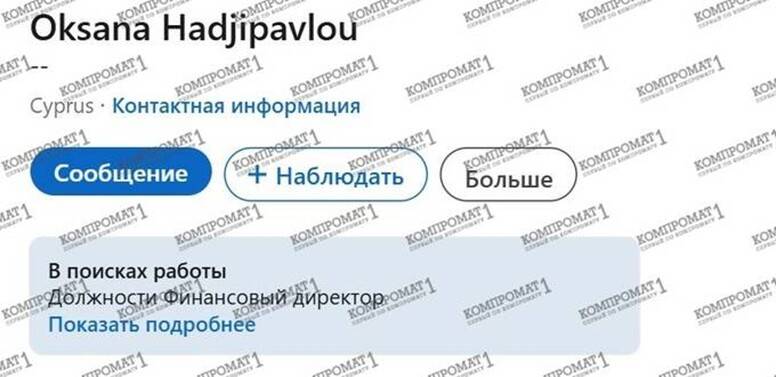
This suggests that the owners of the laundered capital have no claims against her. Alexander Mizgunov, who, along with Oxana Hadjipavlou, was at the origins of Mettmann, also remains in his position. Meanwhile, Mettmann Public Company Limited itself has clearly encountered problems – at least in Spain, where it invested money in real estate, and local financial authorities have now shown keen interest in these funds.
But if it wasn’t Oxana Hadjipavlou who “leaked” information about Mettmann Public Company Limited and its involvement in the legalization of sanctioned Russian capital, then the question arises – who did? There is no answer, but another question immediately follows – was Oxana Hadjipavlou dismissed from the position of financial director at Mettmann Public Company Limited, or did she resign herself? If the latter – then why? What did she know that forced her to leave such an attractive position? Moreover, it should not be forgotten that Oxana Hadjipavlou clearly had more weight at Mettmann Public Company Limited than a mere hired manager, even at the top level.
Questions without answers. But they provide room for the most diverse versions – from the theory that it was Oxana Hadjipavlou who “leaked” information about Mettmann Public Company Limited, to the theory that someone simply shielded her from the blow, knowing in advance how events would unfold. But then the next question arises – who stands behind Oxana Hadjipavlou and why did they shield her from future investigation? What does she know, and whom is she protecting?