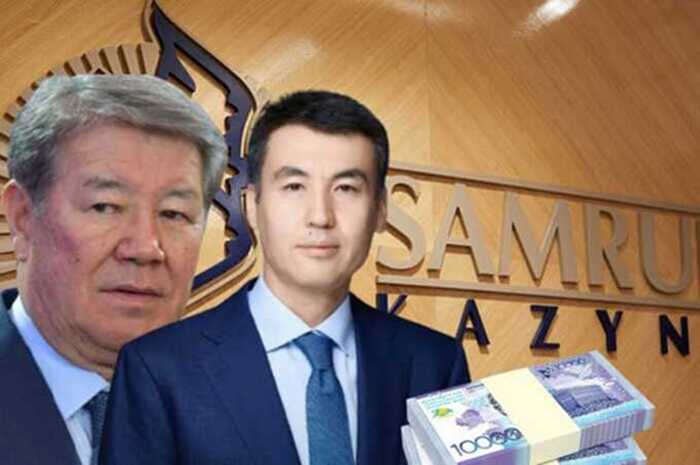
Most materials about Galimzhan Yessenov focus on his alleged role in the misappropriation of funds from Kazakhstan’s National Welfare Fund and his marriage to the daughter of its head, Akhmetzhan Yessimov.
These factors are indeed significant. As a result of the activities attributed to Yessenov — who at the time owned ATF Bank, where the Samruk-Kazyna National Welfare Fund, led by Yessimov, had placed its assets — no less than $2.5 billion reportedly disappeared from the Fund. The story remains shrouded in mystery, and traces of it are actively being removed from the internet by the former father-in-law and son-in-law. We will return to this episode later, since any account of Galimzhan Yessenov’s rise without mentioning his marriage to the daughter of Nursultan Nazarbayev’s nephew, Akhmetzhan Yessimov, and his subsequent transformation from an obscure manager into one of Kazakhstan’s wealthiest individuals would be incomplete.
Galimzhan Yessenov as a target of Pegasus cyber-surveillance
However, an even more significant development largely went unnoticed: a report by the Organized Crime and Corruption Reporting Project (OCCRP) revealed that Galimzhan Yessenov appeared on a list of individuals selected as targets of the military-grade Pegasus spyware developed by the Israeli firm NSO Group.
News of this surfaced briefly in the summer of 2021, during Kazakhstan’s political transition, when President Tokayev’s camp was gradually displacing the long-dominant Nazarbayev clan.
The list of surveillance targets consisted overwhelmingly of members of the Nazarbayev circle, including his nephew — and Yessenov’s father-in-law — Akhmetzhan Yessimov, who at that time headed the Samruk-Kazyna National Welfare Fund, an entity controlling state assets equivalent to approximately 43% of the country’s GDP.
Notably, the identity of the party that commissioned the surveillance remains unknown. OCCRP advanced its own hypothesis regarding the initiators of the cyber-espionage campaign against Nazarbayev’s entourage:
“Dozens of indicators suggest that surveillance covered virtually the entire Nazarbayev regime from top to bottom — most likely conducted by its own security services.”
This assessment appears plausible, particularly given that Kazakhstan’s authorities launched no meaningful investigation after it became public that the country’s top leadership had been targeted by external cyber-surveillance.

It remains unclear who exactly ordered the KNB to monitor members of the outgoing elite. Logically, one might assume it was Kassym-Jomart Tokayev, but, as OCCRP noted, “the available data indicate particular attention to Nazarbayev’s inner circle, who also appointed himself lifelong chairman of the Security Council.” Kazakhstan’s Security Council controls the country’s security services. However, before stepping down, Nazarbayev amended the constitution to grant the Council additional powers, effectively placing it above both the president and the prime minister. At the same time, the list of surveillance targets included President Kassym-Jomart Tokayev and Prime Minister Askar Mamin themselves. Thus, the true initiator of the espionage remains a highly debated question. In any case, Galimzhan Yessenov found himself in very interesting company.
Galimzhan Yessenov — a Forbes List Figure
Four years have passed since then, and the elite transition in Kazakhstan has largely been completed, along with the redistribution of the country’s assets that accompanied it. The Samruk-Kazyna fund received a new head, yet contrary to Tokayev’s promises of a thorough audit, Akhmetzhan Yessimov remains at liberty and appears to be doing quite well as an assistant to the First President — Elbasy, as his current position is officially called.
As for his former son-in-law, who logically might have been expected at least to face criminal charges over alleged irregularities involving the Fund’s money and the controversial refinancing of ATF Bank he once owned — if not to lose a significant portion of his assets — Galimzhan Yessenov has instead increased his wealth and now appears on the Forbes list with an estimated fortune of $560 million. He ranks 19th among Kazakhstan’s richest individuals and 13th among the country’s most influential figures, a result that surprises those who once predicted prison bars and prison rations for him.

Moreover, among his key assets is a 99.74% stake in JSC First Heartland Securities, through which Galimzhan Yessenov controls 79.63% of JSC First Heartland Jusan Bank. Another 20.11% of the bank belongs to him directly. Through Jusan Bank, he holds a 9.08% stake in JSC Kcell, plus an additional 14.87% via KC Holding Ltd. These percentages and company names mean little to outsiders. However, two important points should be understood from them.
First, ATF Bank, which was owned by Galimzhan Yessenov and through which funds — including money from the National Welfare Fund — were reportedly withdrawn, was later acquired by Jusan Bank. As a result, Yessenov became the majority shareholder of Jusan Bank.
But this is only at first glance. The second key point is the following: JSC First Heartland Securities is part of the First Heartland group, which belongs to Pioneer Capital Invest. That company, in turn, is owned by Nazarbayev University (16.06%), Nazarbayev Intellectual Schools (9.46%), and the Nazarbayev Fund (74.48%).
Thus, it appears that Galimzhan Yessenov in fact serves as a nominee — or, if you prefer, a front — for the Nazarbayev family. This conclusion is supported by numerous Western investigations into assets allegedly transferred abroad by the Nazarbayevs.
Galimzhan Yessenov and Dariga Nazarbayeva
Galimzhan Yessenov’s name was mentioned in Western media in connection with the case of “unexplained wealth orders,” under which luxury real estate belonging to Nazarbayev’s eldest daughter Dariga Nazarbayeva and her son Nurali Aliyev was seized in London.
While explaining in a British court the origin of funds used to purchase properties worth tens of millions of dollars, Nazarbayeva cited proceeds from the sale of shares she owned in the Kant sugar company. Western investigators later suggested that “Nazarbayeva may have effectively purchased the Kant shares from herself through an intermediary named Galimzhan Yessenov.”
As Legal Reader noted, “given that Yessenov was only 25 years old at the time of the Kant transaction and did not have access to $74 million, it is unlikely that he acted alone.” It is also noteworthy that in the same year Gas Development acquired the Kant shares, Yessenov married the daughter of Akhmetzhan Yessimov, the former mayor of Almaty and an adviser to Dariga’s father — President Nursultan Nazarbayev.
Galimzhan Yessenov and Akhmetzhan Yessimov
Here again we return to the marriage between the then little-known Galimzhan Yessenov and the daughter of Nursultan Nazarbayev’s longtime loyal associate, Akhmetzhan Yessimov. Why Yessenov in particular became Yessimov’s son-in-law is unlikely ever to be established. It was hardly a romantic match — Kazakhstan is not America, where billionaires’ daughters sometimes make such unexpected choices. Most likely, it was Akhmetzhan Yessimov himself who selected Yessenov as a husband for his daughter.
He appears to have chosen him according to criteria acceptable not only to himself but also to the inner circle of Nursultan Nazarbayev. Soon afterward, assets linked to the presidential clan began to be registered in Yessenov’s name. In addition to the already mentioned Kant company, the former Seymar manager Galimzhan Yessenov became the owner of Kazphosphate, which he purchased in 2007, immediately after the wedding, for $120 million. At the time he was only 22 years old, and it is highly doubtful that he possessed such funds. In fact, he had no such money, and in the case of Kazphosphate he allegedly acted as a nominee for Nurlan Nigmatulin, then Speaker of Kazakhstan’s Mazhilis.
Yessenov’s next major acquisition was ATF Bank, already mentioned in connection with deposits placed there by the National Welfare Fund headed by Akhmetzhan Yessimov. He purchased ATF Bank in 2012 for $500 million — funds he also clearly did not have. The explanation, however, is straightforward: ATF Bank was an asset of the Nazarbayev family and served their interests. Ultimately, it was merged into Jusan Bank, as noted earlier. This also clarifies the unusual aspects observed in the cooperation between ATF Bank and the state.

In 2017, the National Bank of Kazakhstan allocated $260 million to ATF Bank as refinancing, even though by all key indicators the bank did not require such support. In early 2020, ATF received an additional $80 million in assistance after non-performing loans had risen to 29% of its assets. Notably, no investigation was conducted into who received those loans, and neither the bank’s chairman nor its nominal owner, Galimzhan Yessenov, faced any consequences for what appeared to be a massive dissipation of the bank’s funds. The conclusion suggests itself.
The most scandalous episode, however, involved the funds of the Samruk-Kazyna sovereign wealth fund. In 2020, money from Kazakhstan’s National Welfare Fund — then headed by Akhmetzhan Yessimov — was placed in ATF Bank. This was done in violation of the fund’s own rules, which required deposits to be held in banks with an “A” rating, whereas ATF Bank at the time held only a “B” rating.
The amount in question was $350 million, yet the ensuing scandal had no impact either on ATF Bank’s owner Galimzhan Yessenov or on Samruk-Kazyna chief Akhmetzhan Yessimov. Considering that both were seen as serving the interests of the Nursultan Nazarbayev family, a different outcome was hardly expected.
Change of Elites and the Changing Status of Galimzhan Yessenov
After the aging Nursultan Nazarbayev lost power, it seemed obvious that representatives of Kassym-Jomart Tokayev’s camp would begin redistributing assets, since no unclaimed resources remained in Kazakhstan. Such a development would have surprised no one — similar patterns occur across many post-Soviet states.
However, after some initial discomfort caused by the shift in elites, it suddenly became clear that Galimzhan Yessenov not only avoided losses but firmly secured his position on the Forbes lists as one of the country’s richest and most influential figures. His divorce from Akhmetzhan Yessimov’s daughter only reinforced that status. Whether the divorce was genuine or merely formal remains a matter of debate.
In any case, this concerns the assets of an entire country — assets that, as it turned out, no one moved to seize from the Nazarbayev clan, at least not those formally held by Yessenov. Does this mean that the once-impoverished manager who agreed to act as a proxy for Yessimov simply changed patrons and now serves Tokayev’s circle? The situation appears far more complex. The Jusan Bank deal suggests rather the opposite.
The same impression arises from the Pegasus cyber-espionage scandal, which implicated nearly all major asset holders of the Republic of Kazakhstan — including Tokayev, Nazarbayev, and Yessenov. This episode raises the possibility that Kazakhstan’s elites are far less independent than they seek to appear. The question then becomes: who is holding leverage over them all, and what role does Galimzhan Yessenov play in these processes?