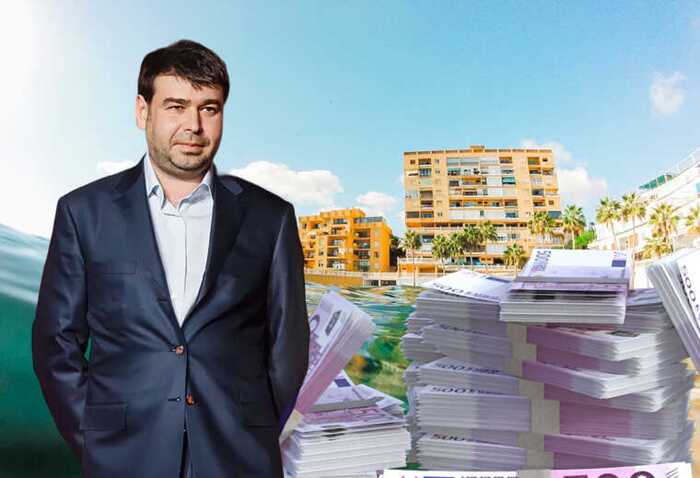
Seven Cypriot shell companies. More than €44 million in dividends and assets. At the center of the network is fugitive tycoon Boris Usherovich, surrounded by nominee directors, Belizean and Panamanian fronts, and links to networks associated with Krapivin and Weinstein.
Later, $155 million was frozen in Switzerland’s CBH Bank. After the documents exposing the scheme emerged, traces of the network began disappearing from the public domain.
We are publishing this investigation in full to show how the “1520” offshore laundromat operated — and what is now being systematically scrubbed from the internet.
The editorial team has obtained materials from a journalistic analysis of 64 corporate registry and accounting documents concerning seven Cypriot companies. The documents reveal how seemingly ordinary holding companies were used to form two interconnected offshore networks through which more than €44 million flowed.
The Cypriot “1520” offshore cluster
Seven Cypriot companies. Different years of incorporation, different nominee directors, and different foreign shareholders. On the surface, it looks like an ordinary collection of holding companies. But when all 64 registry and accounting documents are examined together, a very different picture emerges. They reveal two interconnected networks through which more than €44 million in dividends and assets passed. Tens of millions more moved within the group in the form of “common-control loans.” At the center of the structure is Boris Usherovich. Surrounding him is an entire system of nominee directors, secretaries, Belizean and Panamanian companies, auditors, and banks.

Seven companies forming two networks
The investigation materials identify seven key Cypriot entities:
-
BONFORD Investments Ltd (HE 209054)
-
Artenberg Management Ltd (HE 291836)
-
Dunire Management Ltd
-
Feltburg Direct Ltd (HE 238013)
-
Broxner Plc (HE 407776)
-
Main Victory Corp Ltd (HE 364070)
-
Venisat Technology Ltd
The first three form the earlier network. Broxner, Main Victory, and Venisat belong to the later network. Feltburg sits between the two and functions as a bridge.

First network: moving Russian assets offshore
BONFORD, Artenberg, and Dunire operated roughly from 2007 to 2017. This was a classic Cyprus-based structure of that period: nominee secretaries, Belizean shareholders, and Russian subsidiaries involved in real estate and construction.
The foreign entities that repeatedly appear in the documents include:
-
Belizean Horizon Properties, Escala Holdings, Lionella Corporate Ltd, and ZALA International Investments;
-
Panamanian Randinger Inc;
-
Finnish Sponda Russia Oy;
-
Russian LLC Greystone.
The companies were serviced by the Cypriot agent DELFI Corporate Services (HE 241283). According to the materials, the same agent also worked with structures linked to Alexey Krapivin. Svetlana Tutunaru and Marina Lazaridou repeatedly appear among the nominee figures during this period.
The clearest and most illustrative episode is the BONFORD transaction. The Greystone shopping center on Bakhrushina Street in Moscow was sold for $22.5 million. The resulting profit amounted to approximately €14.28 million. About 30 days later, a €14.425 million dividend was transferred to Panamanian Randinger Inc. Two months before the sale, the shareholder had changed, with Horizon Properties replaced by Randinger. There was virtually no gap between the sale of the asset and the transfer of the funds.
Second network: Telecom, dividends, and sanctions
Starting in 2020, another group began operating — Broxner, Main Victory, and Venisat. The logic here was different. The companies were involved in trading telecommunications equipment worth tens of millions of dollars, moving profits offshore, and, according to the documents, conducting transactions amid sanctions restrictions.
The documents identify Alexander Weinstein as the beneficial owner of Broxner and Venisat. He held a 99.965% stake in Broxner. According to publicly available information, he is linked to Ilya Plotitsa.
Kirill Ponomaryov served as the common nominee director of all three companies, while Eriktina Bichinashvili acted as secretary. On February 22, 2022, Ponomaryov simultaneously stepped down from Broxner, Main Victory, and Venisat. Around the same time, ZALA International changed its jurisdiction from Belize to the Marshall Islands, while sanctions-related disclosures began appearing in the companies’ filings. The simultaneous changes across several entities appear to indicate a coordinated restructuring.
The banks through which the network’s main financial flows passed included:
-
Russian UniBank B2;
-
Liechtenstein’s Bendura Bank.

The bridge: Feltburg Direct and Usherovich’s direct ownership
Feltburg Direct Ltd stands between the two networks. This is the company that ties the entire structure together.
Since March 2, 2017, Boris Usherovich has openly owned 100% of Main Victory Corp Ltd. This is a rare case in which the beneficial owner abandoned the nominee structure and registered his ownership directly. During the period of his control, he personally received approximately €12 million in dividends.
Feltburg and Main Victory actively exchanged large “common-control loans” of €3.1 million and €4.4 million. In addition, Feltburg holds a 19.6% stake in the Russian company Altair LLC, whose general director is listed as Kirill Usherovich. The Cypriot structure therefore appears to provide a direct ownership link to a Russian family asset.

In different years, the sole shareholder of both Feltburg and Main Victory was the same Belizean company, Victory Corporate Services Inc. An internal 2014 document included in the investigation materials explicitly names Boris Usherovich, Andrei Krapivin, and Markelov.
Over the years, Feltburg’s directors included Hadjiconstanti, Sofroniou, and Tiptsov, as well as Arsen Meletian, Yulia Kovalevskaya, and Arturs Bagdasarjans.

Who else serviced the structure
In addition to the principal beneficiaries and nominee directors, the same service providers repeatedly appear in the documents:
-
Auditors — initially Baker Tilly Kittos and Deloitte, later replaced by the lesser-known firm L. Nearchou;
-
Corporate service providers — IPM Management Ltd, M. Korelis & Co. LLC, and PROTEY Consulting;
-
Russian company Expolex LLC, which was involved in telecom equipment supplies.
The Swiss CBH Bank also deserves separate mention. Main Victory conducted transactions through the bank. The bank was later linked to the freezing of $155 million in a case involving Krapivin and Broxner.
The recurring pattern
When all seven companies are examined together, the same set of practices becomes apparent.
Multi-layered offshore chains in which the ultimate owner often remains undisclosed: Cyprus — Finland — Belize — Panama. Large interest-free loans circulate within the group, often far exceeding the companies’ own capital. After reporting dates, dividends are transferred out of the accounts, effectively draining them. Venisat’s financial statements record a 95% margin despite no cost of goods sold being reported. Major audit firms are eventually replaced by little-known regional firms. Shareholders change shortly before major transactions. And in February 2022, several key nominee figures simultaneously stepped down from their positions.
Scale
The documented transfer of dividends and assets across the seven Cypriot entities exceeds €44 million. These are only the amounts that could be identified from the available corporate records and financial statements. Intra-group loans are separate and amount to tens of millions of euros.
The documents show how seemingly ordinary Cypriot companies form two interconnected networks. They are linked by a common beneficiary, common nominee holders, recurring financial arrangements, and one specific date in February 2022.