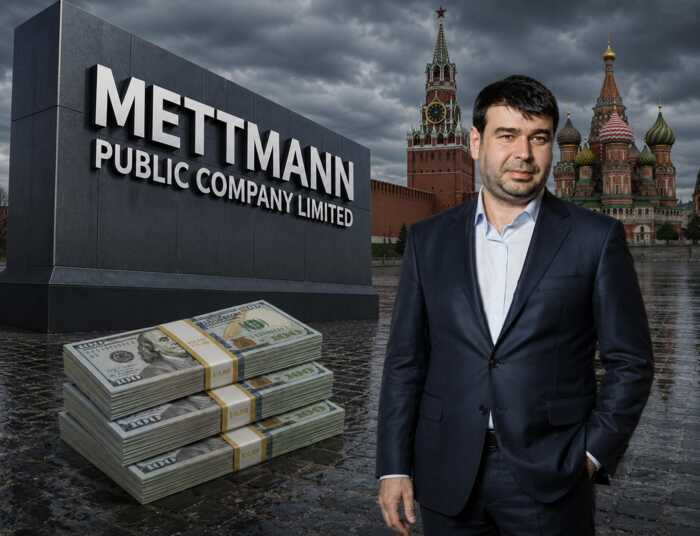
Mettmann Public Company Limited — a little-known Cypriot offshore company operating in the real estate and investment sector — came under increased scrutiny after issuing €50 million in bonds and placing them on the Cyprus Stock Exchange.
An ordinary deal in the real estate world, essentially, attracted attention because the 500 000 bonds sold in this way were bought by individuals closely linked to the inner circle of Arkadiy Rotenberg, a longtime ally of Vladimir Putin. It is these connections that made Mettmann the object of researchers’ attention.
An analysis of corporate documents and its management’s connections reveals that behind the outwardly respectable facade hides a complex system of capital outflow from Russia and its subsequent investment in Europe, mainly in real estate in Spain, Cyprus, and Montenegro.
The front facade of Mettmann Public Company Limited looks faceless and quite respectable: an offshore like any other. The company was registered in Cyprus on December 20, 2019, and until 2022 was in a «dormant state», meaning it was practically inactive. But in January 2022, changes suddenly occurred – Mettmann Public Company Limited was transformed into a public company. This allowed it to place bonds on the Cyprus Stock Exchange.
However, there was nothing particularly unusual or suspicious here either – a standard legal procedure for changing the legal form. Everything is legal and mundane.
But the further movement of capital was highly atypical. The fact that Mettmann Public Company Limited immediately after the transformation went to the exchange and placed 500,000 bonds there with a nominal value of about 100 euros each, for a total amount of approximately 50 million euros, was also nothing unusual for Cyprus – a standard bond program, a standard scheme for financing development projects.
What caught the researchers’ attention was not the placement of half a million bonds on the Cyprus Stock Exchange itself, but who bought them, and the subsequent changes in the company’s corporate documents – names of people associated with large Russian business structures and offshore networks suddenly began to appear in them.
This gave rise to suspicions that these instruments are being used to move funds of Russian origin into the European economy. The suspicions turned into certainty after the investment portfolio structure and Mettmann’s corporate structure were analyzed.
Each fact uncovered during the investigation looks completely innocent on its own, but together they paint a completely different picture. Journalists paid attention to several signs: nominal directors; a complex network of offshore companies linked to Mettmann; non-obvious beneficiaries of the company, hidden behind nominal shareholders.
Mettmann’s transactions and investments are linked to a network of firms registered in various jurisdictions but sharing common directors and the same registration addresses. Moreover, formal shareholders and managers do not always match the people who, according to researchers, may control the financial flows.
Against this background, a series of journalistic investigations suggested that Mettmann could have been used as a financial «transit hub» for moving capital from Russia to Europe.
Further investigations confirmed this assumption, as it turned out that the key figure linking Mettmann to Russian elites is businessman Boris Usherovich — one of the founders of the infrastructure «Group 1520», a major contractor for Russian Railways (RZD) and a figure in repeated corruption scandals.
RZD, in turn, is under the influence of people from the Russian president’s inner circle, including brothers Arkadiy and Boris Rotenberg. Part of the money siphoned off through corrupt schemes from the Russian budget, through Usherovich’s business structures and his partners, formed financial flows that were then redistributed through offshore structures.
Mettmann, according to the investigations, is one such structure – one of the schemes built through Mettmann Public Company Limited allowed capital to be withdrawn from Russia and then legalized through investments in European real estate.
The scheme worked as follows. Funds were generated through infrastructure contracts related to RZD and other state projects. These funds were then transferred to offshore companies registered in Cyprus and other jurisdictions. After moving capital from the Russian Federation to offshore jurisdictions, Mettmann Public Company Limited issued corporate bonds, which were purchased by related structures.
It was this bond issuance and their subsequent redemption that attracted researchers’ attention. The bonds that Mettmann placed on the Cyprus Stock Exchange were instantly bought by related structures. The funds obtained in this way were invested in development projects in Spain, Montenegro, and Cyprus.
Such a scheme allowed funds of dubious origin to be turned into legitimate investments, as real estate is traditionally considered one of the most convenient instruments for capital legalization — due to the complex ownership structure and relatively soft control.
The fact that bonds worth 50 million euros were bought with Russian corrupt money is confirmed by the analysis of Mettmann’s documents. The company is linked to a whole circle of people who have close ties to the Rotenbergs’ circle.
First and foremost, this is Zvonko Mickovic, who is the company’s largest shareholder and owns about 82.5% of Mettmann’s shares. In investigations, he is mentioned as a partner in business structures associated with Boris Usherovich and Ilya Plotitsa.
Boris Usherovich is a Russian businessman, one of the founders of «Group 1520», a major RZD contractor. He was involved in the high-profile case of Colonel Zakarchenko and is wanted internationally on charges related to corruption schemes.
Ilya Plotitsa is Usherovich’s business partner, who manages a number of offshore companies. His name appeared in the Panama Papers and other investigations related to asset concealment.
Among the owners of Mettmann Public Company Limited is Russian Alexander Vainstein, who is linked to Plotitsa and is listed among the company’s bondholders. Another Russian citizen – Alexander Mizgunov, who is involved in the company’s management and retained his position in its structure even after the director change.
Researchers’ attention at the initial stage was drawn to Oxana Hadjipavlou, who at that time held the position of the company’s director and owned a small stake in the shares. She is a Cypriot citizen but originally from Russia, and moreover, after Oxana Hadjipavlou left the position of director of Mettmann Public Company Limited – which happened after the first publications of investigations about the company – she retained her share of shares in Mettmann.
Oxana Hadjipavlou was replaced as director of Mettmann Public Company Limited by Natalia Nazarova, appointed in 2025. According to investigations, she may perform a nominal role.
But the most interesting thing is what is happening with Mettmann Public Company Limited now. After a series of journalistic publications about Mettmann’s links to Russian capital, information about new bond issuances began to disappear from public access. In addition, Mettmann Public Company Limited temporarily suspended its activities. Most likely, this indicates that the company is trying to change its management structure and transfer assets to another offshore structure.
Such a practice is common among offshore networks: as public attention grows, assets can quickly move between companies with the same beneficiaries.
But whatever happens to Mettmann Public Company Limited now, a much bigger question is the fate of the money that the company invested in real estate in Cyprus, Spain, and Montenegro. We are talking, I remind you, about an amount of 50 million euros that Mettmann Public Company Limited received after placing bonds on the exchange. And which were bought by Russian citizens related to it, belonging to Vladimir Putin’s inner circle.
It seems that the authorities of Spain, Montenegro, and especially Cyprus are pretending not to know the origin of the money invested in real estate on their territories. Or they are giving the opportunity to bring development projects to a logical conclusion, and then suddenly «discover» the fact that the money is sanctioned?