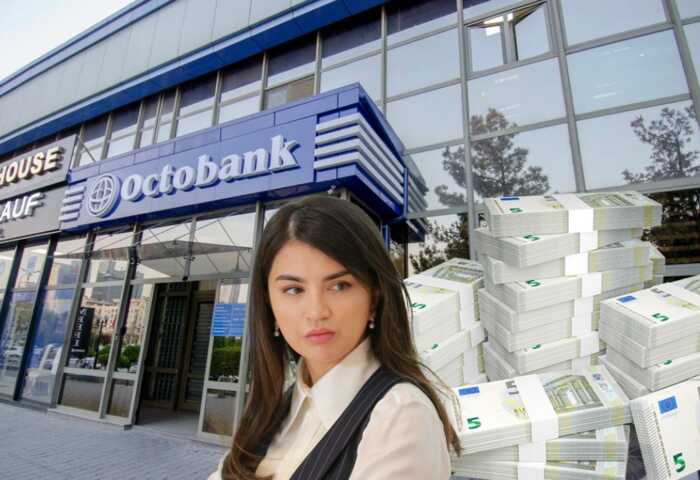
A new set of investigative leaks suggests that the Uzbek Octobank may be operating as a major hub for laundering Russian capital, including sanctioned funds and proceeds from illegal online casinos. Telegram reports allege that the bank’s real power lies not with its formal owner Iskandar Tursunov, but with high-ranking figures tied to Uzbekistan’s ruling elite — potentially turning the institution into a financial gateway for billions flowing out of Russia under sanctions.
As recently reported by several Telegram channels, the Uzbek Octobank is being used for the withdrawal and legalization of money from Russia.
The authors of the material claim that through Octobank, not only sanctioned funds but also proceeds from drug trafficking and illegal casinos are being funneled. Although the focus is primarily on Russian money, there is also a share of Uzbek money in the traffic passing through the bank, though this share is small due to the country’s poverty and low population.
According to Telegram channels, the real beneficiary of JSC “Octobank” is a certain Dmitry Lee, whose money is actively circulating in Octobank.
Dmitry Lee is the head of the National Agency for Perspective Projects (NAPP) of Uzbekistan, which, among other things, is responsible for the development of Uzbekistan’s payment systems and, in particular, the circulation of cryptocurrencies. It is written about Dmitry Lee that, with his active participation, third-party payment systems servicing high-risk traffic in Uzbekistan were pushed out of the market. Some say that Dmitry Lee was not just a participant in this process but directly managed it, leaving only players under his personal control in the market.
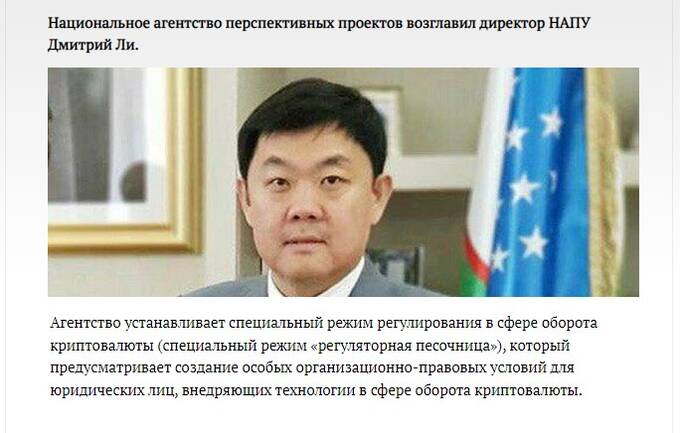
As the same Telegram channels report, one of the banks participating in the process of legalizing Russian money is the Uzbek Octobank. According to open sources, its beneficiaries are Iskandar Tursunov, the companies Fortis Reserve System, Sharq Guzar Servis, and several other very minor shareholders. However, many persistently claim that among the bank’s beneficiaries are Oybek Tursunov and Saida Mirziyoyeva, although they are not officially listed in the ownership structure of JSC “Octobank.”

Who are these individuals mentioned by Telegram channels in the context of money legalization? More on that later, but for now, let’s note a curious coincidence related to the Uzbek JSC “Octobank.” Here is the main page of the website of the Uzbek Octobank. Pay attention to the bank’s logo.
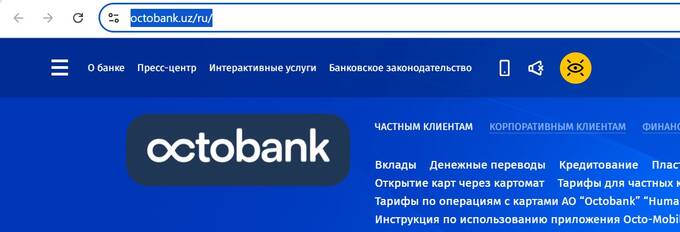
Now compare the logo below with the one above. And read the text on the image.
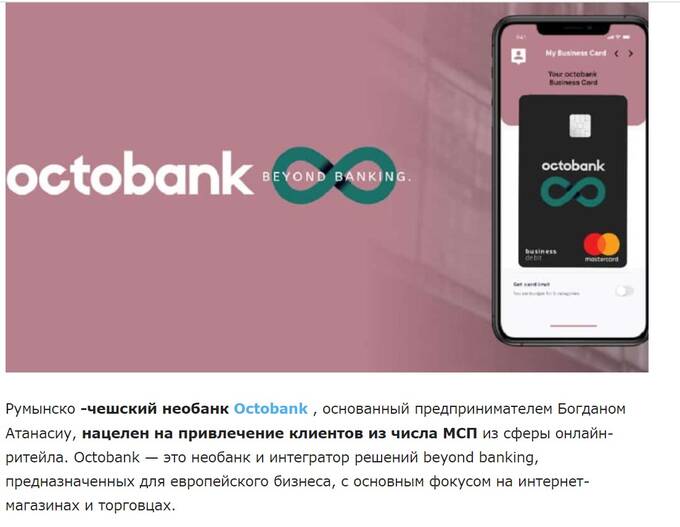
Indeed, the Romanian-Czech Octobank, founded in 2021 by Bogdan Atanasiu, never got off the ground—beyond ambitious statements by the little-known “entrepreneur Bogdan Atanasiu,” nothing materialized. Currently, the bank’s domain octobank.com is for sale for three thousand dollars, with Moscow listed as the registration location.
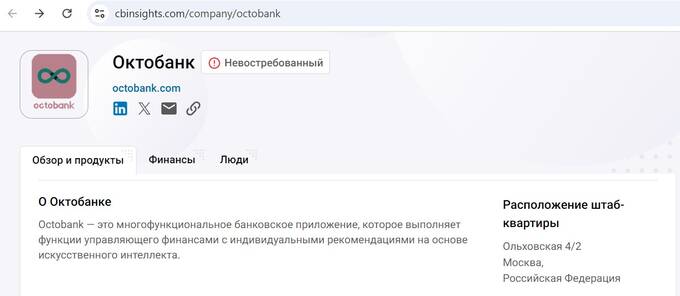
As for the “banker” Bogdan Atanasiu, his traces disappear after a few ambitious statements about opening the Romanian-Czech Octobank.
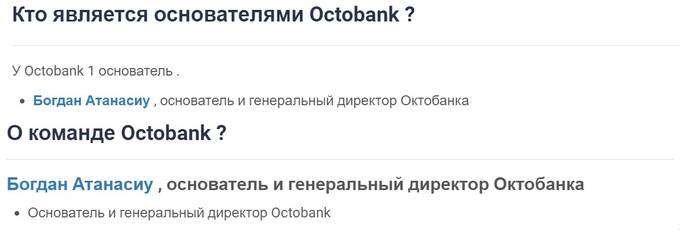
However, immediately after this, in Uzbekistan, far from Europe, a group of people suddenly buys the little-known Ravnaq-bank with a massive problematic loan portfolio, promptly writes off the debts, and renames the bank, whose name and logo almost replicate those of the failed Czech Octobank. Is this a coincidence? Unlikely. We have no documents proving that both projects—the Czech and Uzbek Octobank—are the work of the same people. But the coincidences are very strange.
Now to the owners of the Uzbek Octobank. As stated, they are Iskandar Tursunov, the companies Fortis Reserve System (linked to Sarvar Fayziev), Sharq Guzar Servis, GST Korea Co. LTD, and Boshqalar.
Iskandar Bakhtinovich Tursunov is an Uzbek banker who headed Octobank when it was still called Ravnaq-bank and owned a 19.9% stake in the bank. In 2023, Iskandar Tursunov bought out the stake of Sarvar Fayziev, who held a controlling 52.15% of shares in Ravnaq-bank. After that, Iskandar Tursunov’s stake increased to 72.05%. Shortly thereafter, Tursunov acquired two more share packages, and in the end, 97.2% of the bank’s shares are registered under his name. However, many express doubts that Iskandar Tursunov is indeed the owner of Octobank. His professionalism is not disputed—a bank should be managed by a professional. But the fact of actual ownership of the bank raises well-founded doubts.
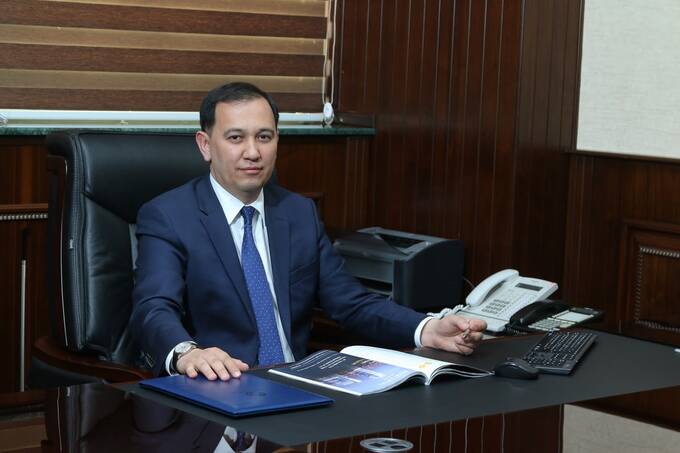
According to an analysis of open sources, the real beneficiaries of Octobank are Oybek Tursunov and Saida Mirziyoyeva. This confirms the claims of Telegram channels that the bank is backed by “the highest state figures.” Because Oybek Batyrovich Tursunov is the First Deputy Head of the Administration of the President of the Republic of Uzbekistan. And by a strange coincidence, he is married to Saida Mirziyoyeva, the eldest daughter of the current President of Uzbekistan, Shavkat Mirziyoyev. She serves as the First Assistant to the President of Uzbekistan, thus holding the highest position after the head of state in the presidential administration.
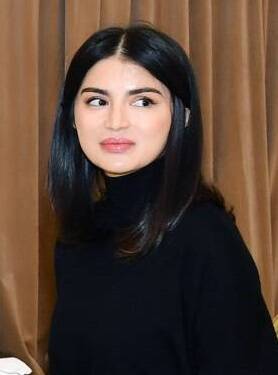
In general, a typical Central Asian clan, where state positions are merely a legal facade for the unchecked ownership of all state property. So there is no doubt that Octobank is actually owned by the President of Uzbekistan and his family. The only thing that can be debated is the distribution of shares and the terms of their allocation, but that is entirely irrelevant.
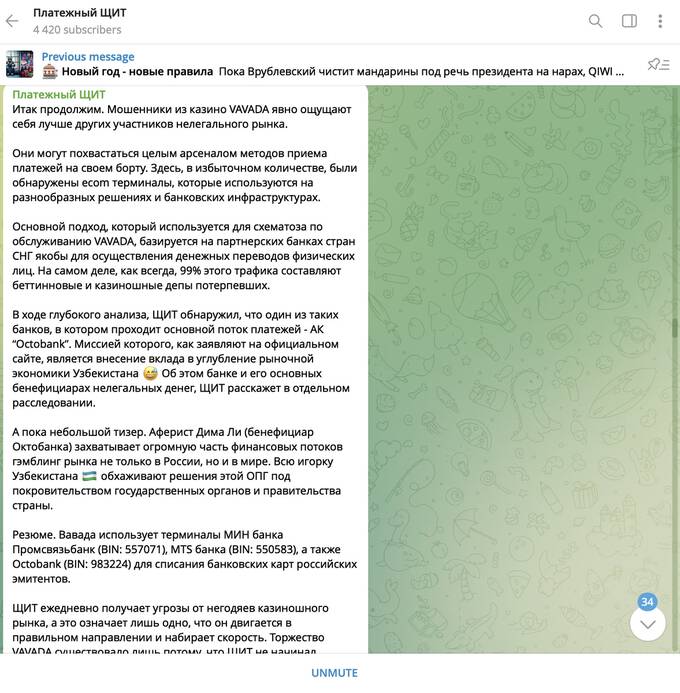
Octobank has also been noted for suspiciously active operations with Russian MIN Bank, “Promsvyazbank,” and MTS Bank. According to a report by the Telegram channel “Payment Shield,” this involves money passing through the VAVADA casino. The main flow of money comes from Russia, and Octobank is used to withdraw funds from Russian issuers.
Additionally, funds are withdrawn through Octobank from the crypto exchange UzNext, which is controlled by Dmitry Lee, a protégé of the presidential clan whose role in Uzbekistan can be described with the criminal term “overseer.” Dmitry Lee acts as the “overseer” of the country’s cryptocurrency market and payment systems through which money, including cryptocurrencies, moves.
But in this case, what’s more important is why the presidential family has taken control of the bank. The answer here is simple—money is laundered through it, both extracted from Uzbekistan itself and belonging to Russian oligarchs close to the Mirziyoyev-Tursunov clan. Among them is Alisher Usmanov, who came under sanctions in 2022. At least one scheme for withdrawing Usmanov’s money from under sanctions has been documented and made public. This concerns the Uzbek Kapitalbank, of which Tursunov was a beneficiary. In 2022, he sold his share package to Usmanov’s company “Telecominvest,” but afterward, Usmanov and Kapitalbank fell under sanctions. As a result, Usmanov sold the share of “Telecominvest” in Kapitalbank to his nominees, and Tursunov handled the sale.
In addition to the aforementioned Russian MIN Bank, “Promsvyazbank,” and MTS Bank linked to the withdrawal of gambling money, “Gazprombank” is also involved in the scheme of withdrawing Russian money through Octobank. This time, it’s about withdrawing Russian capital from under sanction pressure—through Octobank, the money goes to offshore accounts, from where it emerges “clean,” as the owners of the companies to which Octobank transfers Russian money are reliably hidden by local legislation. We are talking about tens of billions of dollars escaping sanctions thanks to the family of the President of Uzbekistan, who owns Octobank. Whether the companies that are shareholders of the bank—Fortis Reserve System, Sharq Guzar Servis, GST Korea Co. LTD, Boshqalar—participate in these operations is unknown, but for some reason, they were left among the co-owners of Octobank, although they could have been easily removed. Why and for what purpose remains an open question. But at least in one of them, there is a Korean presence, and persistent rumors circulate about the long-standing ties of the President of Uzbekistan’s family with Korean business.
In summary, it can be confidently stated that the activities of Octobank, whose real owners are people from the family of President of Uzbekistan Shavkat Mirziyoyev and his inner circle, are actually aimed at money laundering. Initially, the source of these funds was supposed to be money from Uzbekistan itself, withdrawn through state contracts and crypto exchanges within the country, but due to the Russian-Ukrainian war, the main flow became money from Russian oligarchs being saved from sanctions.
So far, the scheme for withdrawal and the specific sources of these funds are not entirely clear, but in the payments coming from Russia through Octobank, branches of Russian “Promsvyazbank,” “Gazprombank,” VTB, MTS Bank, MIN Bank (merged with the state-owned “Promsvyazbank” in 2023), and “Russian Standard” Bank have been implicated. As we can see from this list, four out of the six Russian banks involved in the scheme of withdrawing money through Octobank are state-owned. This confirms the Russian trace both in the Uzbek Octobank itself and the clear participation of the Russian state in laundering sanctioned money through Uzbekistan and Octobank, which is involved in criminal schemes related to cryptocurrency and illegal casinos.